
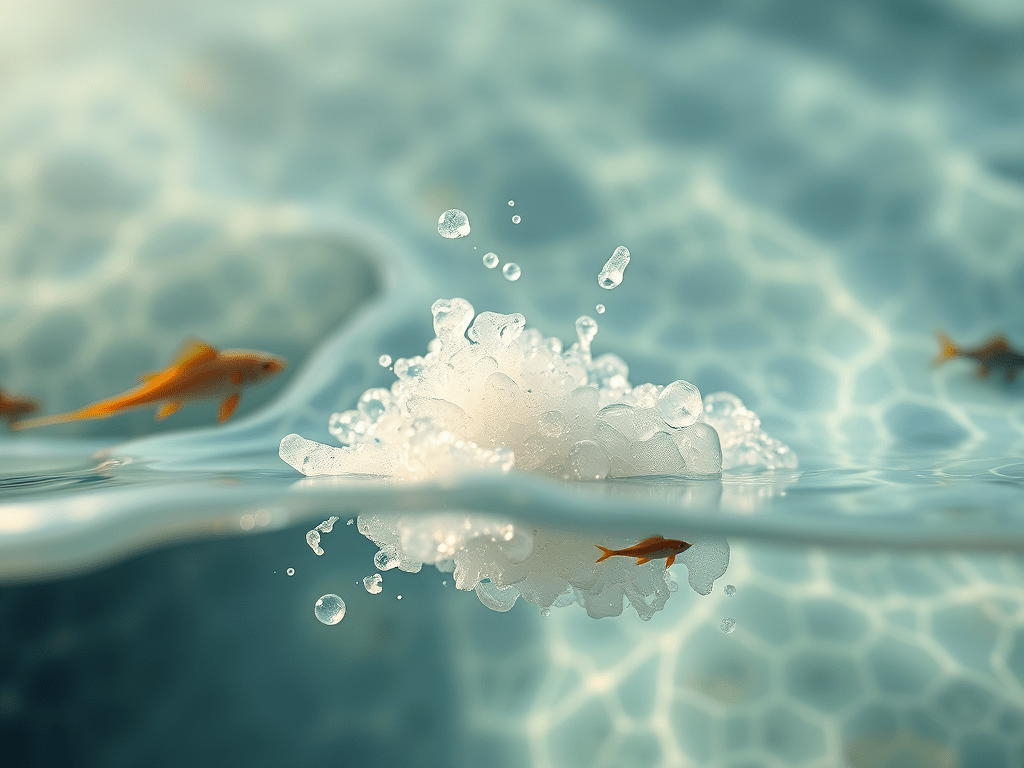
In a quiet lab in Japan, a team of scientists may have just cracked one of the most pressing environmental challenges of our time. Their creation? A plastic-like material that dissolves completely in seawater within two to three hours—leaving behind no microplastics, no toxins, and no carbon emissions.
This isn’t science fiction. It’s real. And it could change everything.
Developed by researchers at RIKEN and The University of Tokyo, this new material behaves like traditional plastic in strength and usability but breaks down rapidly when exposed to saltwater or soil. The implications are massive—not just for marine life but for global sustainability efforts as a whole.
In this article, we’ll break down how this innovation works, what makes it different, the challenges to scaling it up, and what a world with zero microplastic pollution could actually look like.
THE SCALE OF THE PLASTIC PROBLEM
Before diving into the science, let’s talk numbers.
- 11 million tonnes of plastic enter our oceans every year.
- The UN estimates plastic pollution will triple by 2040 if we don’t act fast.
- Even so-called “biodegradable” plastics often leave behind microplastics—tiny, persistent fragments that pollute ecosystems and even make their way into human bodies.
Despite decades of warnings and efforts, the plastic problem has only gotten worse. The issue isn’t just that plastic takes hundreds of years to degrade. It’s that in the process, it shatters into dangerous, invisible debris.
What’s been missing? A material that mimics the utility of plastic but doesn’t stick around forever.
HOW DOES THIS NEW MATERIAL WORK?
The secret lies in how plastics are made—and how this new material rethinks that process entirely.
The Basics of Plastic Chemistry
To understand why this Japanese invention is so radical, here’s a quick primer:
- All plastics are polymers: long chains of repeating molecular units called monomers.
- The bond between monomers is typically strong and stable.
- This strength is why plastic is durable—and why it takes decades or centuries to decompose.
So the challenge has always been: how do you make plastic strong and degradable?
The Breakthrough
The Japanese scientists approached the problem at the molecular level.
- They used two specific monomers to form the plastic’s structure.
- These monomers were selected for a highly salt-sensitive bond.
- When the plastic comes into contact with salt—such as in seawater or soil—it triggers a chemical reaction that snaps the bond apart.
- This breakdown produces non-toxic raw materials, which bacteria can consume naturally.
What you’re left with is nothing. No shards. No particles. No long-term residue.
And while most “biodegradable” plastics degrade over months or years—and often incompletely—this material completely dissolves in 2–3 hours in seawater and within 8 days in soil.
OTHER FEATURES THAT MAKE IT REVOLUTIONARY
Let’s take a moment to appreciate just how many boxes this material ticks:
| Feature | Description |
| Non-toxic | Safe for humans, animals, and marine life. |
| Non-flammable | Low fire risk during production and use. |
| Carbon neutral | Doesn’t emit CO₂ during breakdown. |
| Microplastic-free | Completely dissolves into harmless base compounds. |
| High strength | Comparable to conventional plastic in performance. |
This isn’t just about solving plastic pollution—it’s about doing it without compromising on industrial utility.
APPLICATIONS AND USE CASES
If developed at scale, the potential uses are endless:
- Single-use plastics like grocery bags, cutlery, and food wrappers.
- Marine equipment such as fishing nets, which are a major source of ocean plastic waste.
- Agricultural films that could dissolve in soil post-harvest.
- Packaging for consumer goods, especially in industries where short lifespan products dominate.
The short degradation time makes it perfect for products that are intended to be used once and discarded. And unlike compostable plastics that require industrial facilities to break down, this material works anywhere—no special infrastructure needed.
CHALLENGES TO MASS ADOPTION
Of course, a lab success isn’t the same as a global solution. There are several hurdles to overcome before this material becomes mainstream.
1. Cost of Production
Most green alternatives fail to compete with traditional plastics on price. This new material relies on carefully selected monomers and specialized processing, which currently makes it more expensive than petroleum-based plastics.
Researchers are now working on optimizing synthesis methods to make production faster and cheaper.
2. Durability in Diverse Conditions
While it’s strong, the material’s sensitivity to salt can be a downside. In certain applications—say, storing something salty or moist—premature degradation could be a risk. Protective coatings or barrier layers may be needed, which adds complexity.
3. Scalability of Raw Materials
Even if production becomes cheap, sourcing the monomers sustainably at scale is another matter. If demand spikes globally, it’s essential that the raw materials can be supplied without causing other environmental damage.
4. Compatibility with Existing Systems
Our recycling and manufacturing infrastructure is built for petroleum-based plastics. Adapting machines, processes, and logistics to this new material would require significant investment and industry buy-in.
5. Regulation and Certification
Before it hits shelves worldwide, the material needs to pass health, safety, and environmental regulations in dozens of countries. Getting those approvals takes time.
NEXT STEPS IN DEVELOPMENT
According to the RIKEN and University of Tokyo team, the biggest focus now is developing coatings and additives that allow this plastic to be used in more diverse settings without compromising its degradability.
Imagine a waterproof layer that protects the material during use but dissolves away once it hits the environment. That’s the level of engineering they’re aiming for.
Another key area of work is modifying the polymer chain slightly to extend shelf-life without losing biodegradability. It’s a tricky balance—but if they get it right, it could unlock the use of this material in electronics, automotive parts, and even construction.
THE BIGGER PICTURE: ENVIRONMENTAL IMPACT
Let’s return to the big picture.
11 million tonnes of plastic enters the ocean each year. If even a fraction of that could be replaced with this dissolvable plastic, the impact would be enormous:
- Marine life would stop choking on invisible particles.
- Beaches, coral reefs, and riverbeds could finally breathe.
- Cities could reduce landfill overflow and waste processing costs.
- Global CO₂ emissions would drop from reduced plastic incineration.
This material isn’t just cleaner—it’s simpler. No need for high-temperature composting. No reliance on public recycling behavior. No microplastics haunting us for centuries.
It breaks down, gets eaten by bacteria, and disappears.
A MATERIAL DESIGNED TO GO AWAY
In a world obsessed with making things that last forever, this Japanese innovation stands out for its ephemeral genius.
It’s strong when it needs to be. Then, like a ghost, it vanishes—on command, leaving no trace.
That’s not just good science. That’s the kind of thinking the world needs right now.
Of course, there’s still work to do—coatings to develop, supply chains to build, costs to bring down. But the foundation is here. And it’s rock solid.
If the plastic problem feels overwhelming, this invention offers something rare: a clean, elegant solution that actually works.
And maybe—just maybe—that’s the start of something bigger.
Kudos to the RIKEN and University of Tokyo team.
You’ve not just invented a better plastic. You’ve created a blueprint for how science can serve the planet.
 Tech and Tofu
Leave a comment